
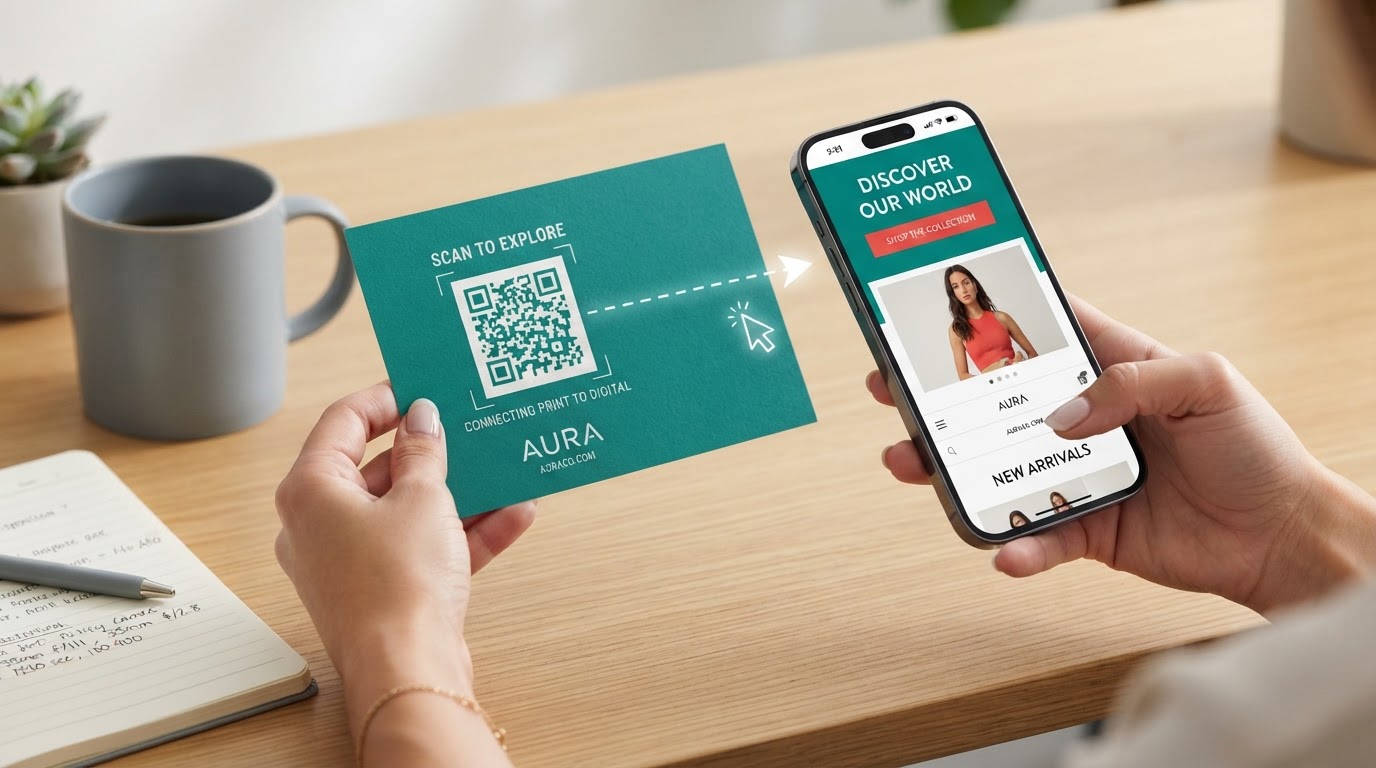
A well-designed postcard lands in the right mailbox. The message is clear, the offer is relevant, and the piece looks exactly like your business. The person holds it for a few seconds, and you have their attention. Then a question shows up that most marketing plans never answer on purpose: what should they do next?
If the next step is fuzzy, the attention you just earned can slip away before it turns into anything. The recipient has to remember your name, search for you later, find the right page, and figure out how to get in touch. Each of those is a chance for them to move on. Print did its job. The journey after the print is where many campaigns quietly lose people.
Print Can Get Attention. What Happens Next?
This is not a criticism of traditional print. Print remains one of the most effective ways to put a real, physical message in someone's hands. A brochure, direct mail piece, or sign has a presence that a digital ad scrolling past does not. The opportunity is not to replace print. It is to decide, in advance, what should happen after the printed piece has done its work.
There is a meaningful difference between handing someone a brochure and handing someone a useful piece of information with a clear next step attached. The first leaves the recipient to figure out the rest. The second respects their time and makes continuing easy.
The Bridge Between Physical and Digital
That is where interactive print marketing comes in. The idea is simple: the printed piece creates the first interaction, and a focused digital destination lets the customer continue on their own terms. The connection can be as straightforward as a postcard with a QR code that leads to a single page built for that campaign. Or a direct mail offer that points to a simple digital response, which then opens the door to follow-up.
The goal is not to make print more complicated. It is to remove the dead end at the end of a printed piece.
Connecting Print and Digital With BOOST.
BOOST. is Bottom Line Digital Communications' coordinated approach to digital marketing, websites, lead capture, print, and direct mail. It helps a printed piece become part of a larger customer journey. smartPRINT has a distinct role: it is an online portal for ordering and reordering approved branded collateral, including support for multiple locations with separate access and permissions.
Depending on the campaign, BOOST. can bring together QR codes, campaign-specific landing pages, forms, event registration, appointment requests, video, or estimate requests. A QR code opens a page; it does not identify the visitor. Lead capture requires the visitor to submit details, and automated follow-up requires appropriate consent and a configured workflow.
The QR Code Is Not the Strategy
QR codes have made the jump from print to digital convenient, and that convenience is worth using. But placing a code on a printed piece does not create a campaign. Before anyone puts a code on a mailer, it is worth asking why someone would scan it, what they will receive, where it will take them, and whether the destination continues the same message. A code pointing to a generic homepage with no clear reason to be there is not a strategy. It is a loose end.
Strategy comes first. The technology supports the objective, not the other way around.
Send People Somewhere That Makes Sense
A focused digital destination can keep the conversation going. Instead of sending someone to a homepage and hoping they find their way, a campaign page can explain the offer, share a video, collect an inquiry, accept a registration, or let someone request an estimate. Not every campaign needs a dedicated page. The destination should simply match the objective.
Keep the Message Consistent
When someone scans a code, the page they land on should feel like the same business that sent the piece. The message, offer, visual identity, photography, and tone should carry over. A customer should never scan and wonder whether they arrived in the wrong place. Because Bottom Line works across print, design, websites, and marketing strategy, those pieces can be built to belong together rather than produced separately and patched up later.
Remove Friction From the Customer Journey
Friction is what kills interest. A journey that asks someone to remember a company, search for it, find the website, locate the right service, and then track down a contact form is full of small exits. A journey that goes from postcard to scan to a relevant page to a simple request is short and obvious. The second path will not always convert better for every audience. It simply removes the unnecessary steps between interest and action.
Make the Experience Worth the Scan
Asking someone to scan a code creates an expectation. There should be a reason: useful information, an exclusive offer, event registration, appointment scheduling, an estimate request, a helpful guide, or a video that adds something the printed piece could not. Vague calls to action like "scan to learn more" ask for effort without promising value. Specific, honest offers respect the person on the other end of the scan.
Interaction Can Create Opportunities for Measurement
Connecting print to digital can also create opportunities to understand engagement. Depending on how a campaign is set up, it may be possible to see QR scans, landing page visits, form submissions, registrations, downloads, or estimate requests. Measurement should be planned before the campaign launches, not bolted on after.
It is worth being honest about the limits. A QR scan does not make print perfectly measurable, and not every interaction can be connected to a specific person. Used thoughtfully, though, a connected campaign can tell you far more than a postcard that disappears into a stack of mail ever could.
The Campaign Should Not End With the Scan
A response is often the beginning of the next phase, not the finish line. When someone fills out a form, who replies, and how quickly? Do they get a helpful email? Should someone call? What happens if they show interest but are not ready to buy? Planning the follow-up is part of the campaign, not an afterthought.
Two Roles in a Coordinated Marketing Plan
BOOST. coordinates the marketing plan across digital marketing, websites, lead capture, print, and direct mail. smartPRINT supports the ordering side: a team can use its branded collateral portal to order approved materials and reorder them consistently. A business may need either service or both. QR landing pages and follow-up belong to campaign planning; the smartPRINT portal handles collateral ordering.
A Practical Example
Consider a Mount Pleasant home service company that wants to reach homeowners in a few specific neighborhoods. They send a clean, well-designed postcard that names a real homeowner problem and offers a clear next step. The card gives a reason to scan: a quick estimate request, not a vague invitation to learn more. The QR code leads to a mobile-friendly page that continues the same message and lets the homeowner request an estimate in a couple of taps. When the request comes in, the company has a defined process for responding quickly. Each step supports the next. This is an illustrative example, not a case study, but it shows how the pieces fit when the campaign is planned as a journey rather than a single object.
Questions to Ask Before Your Next Print Campaign
- Who are we trying to reach, and what problem are we helping them solve?
- What is the single most important message on this piece?
- What do we want them to do after they see it, and why would they take that action?
- Which digital destination best supports that action?
- Does that destination continue the same message and look like the same business?
- Is the experience easy to use on a phone?
- What happens after someone responds, and who owns that follow-up?
- How will we evaluate engagement, and does this campaign connect to the rest of our marketing?
The Takeaway
Print does not need to become digital to stay relevant. Its physical nature is one of its strengths. The opportunity is to connect that physical experience to an appropriate digital next step when doing so makes the customer's journey easier. BOOST. helps plan that connection, while smartPRINT can make ordering and reordering the branded materials easier.
Pull out a postcard, brochure, or leave-behind you already use and ask a simple question: what happens next? Bottom Line Digital Communications can help you think through the audience, message, printed piece, call to action, digital destination, follow-up, and measurement. Bring us the piece, and we will help you see what a clearer next step could look like.
Let's Talk