
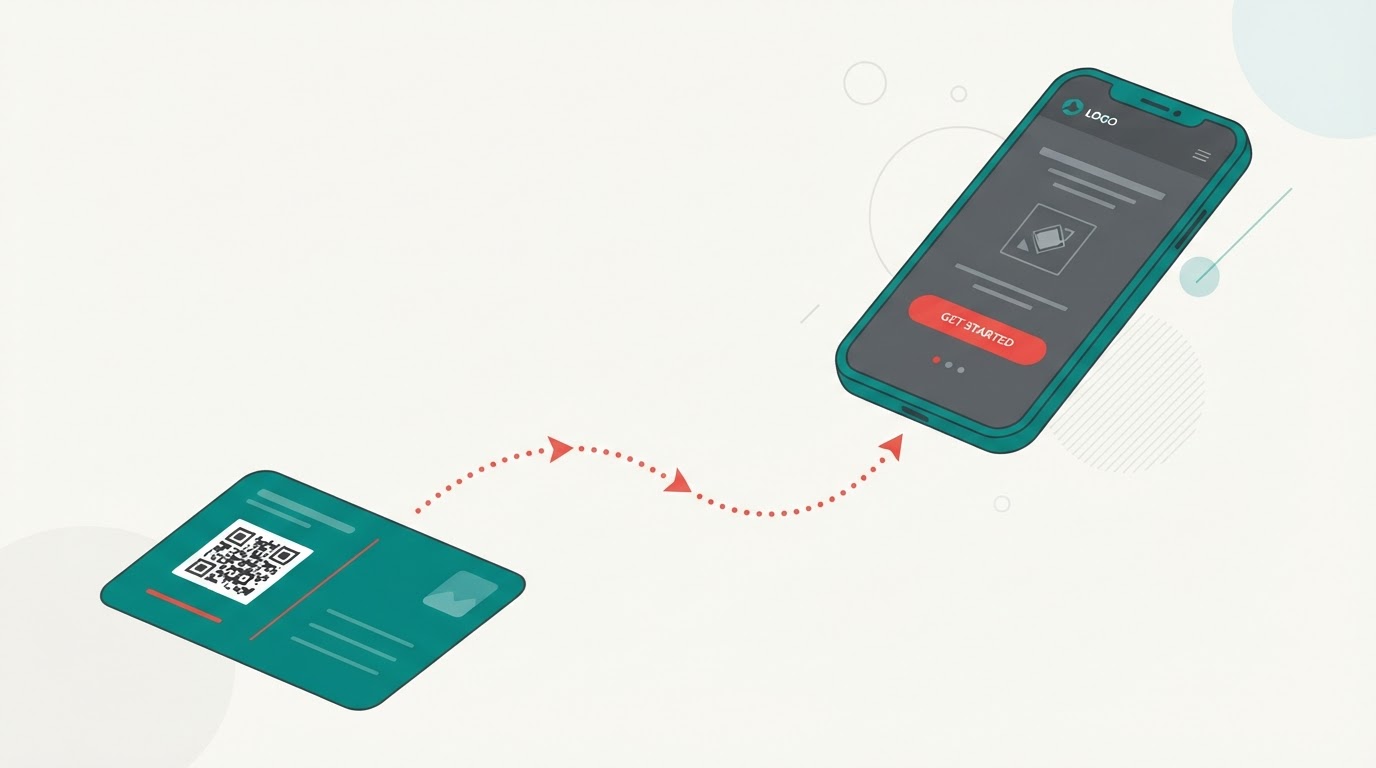
A postcard arrives in the mailbox. The design gets noticed. The message is relevant. The recipient is interested. Then the campaign asks them to do something. That single moment is where the journey either continues or quietly breaks down. Most printed marketing is planned carefully right up until the point of contact, then left to hope the recipient figures out the rest.
Print to digital marketing is about designing that next moment on purpose. The goal is not to turn print into digital. Print has value precisely because it is physical. The opportunity is to let each channel do what it does well so a printed piece becomes the start of a customer journey instead of the end of it.
Start With the Destination, Not the QR Code
Before deciding where to place a QR code, decide what you want the recipient to do after they receive the piece. Should they request an estimate, schedule an appointment, register for an event, redeem an offer, make a donation, watch a demonstration, download useful information, or request a consultation?
Once the desired action is clear, you can work backward. The action tells you what the digital destination needs to do. The destination tells you what the call to action should say. The call to action tells you what message belongs on the printed piece. Planning in that order keeps the campaign pointed at a real outcome instead of starting with a piece of technology and improvising around it.
Give People a Reason to Move From Print to Mobile
Placing a QR code on a postcard does not give someone a reason to scan it. The recipient has to understand what happens after the scan and why it is worth their time. Vague calls to action like "Scan Here" or "Scan to Learn More" ask for effort without promising anything in return.
A stronger call to action communicates value. "See Available Appointment Times," "Get the Homeowner's Checklist," "Reserve Your Seat," "Request Your Estimate," or "See the Full Property Details" each tell the recipient exactly what they get for scanning. The effort now has a clear payoff.
Make the Physical-to-Digital Step Easy
The connection between the printed piece and the mobile experience should be obvious and effortless. The QR code needs enough size and contrast to scan reliably. It belongs where the eye naturally lands, near the call to action. A short, readable URL can help when a code might be awkward or when someone is viewing the piece in a context where scanning is hard.
Before the piece goes to press, test the full experience. Scan the code, follow the path, and check the destination on an actual phone. A surprising number of campaigns fail at this step because the destination loads slowly, sends people to the wrong page, or simply does not work.
Do Not Send Everyone to Your Homepage
A homepage is built to serve many audiences. A postcard is built to serve one. When the postcard promotes a single service, offer, event, or opportunity, sending the recipient to a general homepage forces them to hunt for what the printed piece already promised them. That extra work is friction, and friction is where interest goes to cool off.
A focused landing page can continue the specific conversation the printed piece started. Not every campaign needs a dedicated page. But when the printed message is specific, the destination should match it.
Make the Digital Experience Feel Like a Continuation
When someone scans, the page they land on should answer one question right away: is this what I expected? The headline, offer, imagery, and tone should carry over from the printed piece so the transition feels natural rather than disorienting. A customer should never scan a code and wonder whether they ended up in the wrong place.
Because Bottom Line works across print, design, websites, and marketing strategy, those pieces can be built to belong together from the start, instead of produced separately and patched up later.
Design for the Phone in Someone's Hand
If someone scans a QR code, they are almost certainly holding a phone. The destination should be built for that reality. A clear headline, readable text, fast access to the important information, and large, obvious buttons all matter more on a small screen. Short forms, easy tap-to-call actions, and simple appointment requests keep the path short.
Clutter that feels manageable on a desktop becomes a wall on a phone. When the entire experience is built around the moment someone is actually in, it stays easy to use.
Ask Only for What You Actually Need
Every form field is a small decision the customer has to make, and each one is a chance to stop. A request for an estimate needs different information than an event registration. The amount you ask for should match the value being offered and the next step you want them to take. There is no universal ideal length. The principle is to request only what you will actually use to respond well.
Plan What Happens After the Response
The journey should offer a clear next step after a scan or click. Lead capture requires the visitor to submit their details. Automated email or SMS follow-up requires appropriate consent and a configured workflow. Decide in advance who receives an inquiry, how the team should respond, and whether the configured system sends a confirmation.
Think about the prospect who is interested but not ready to buy. A clear next step for them keeps the relationship warm instead of dropping it. Planning follow-up is part of the campaign, not something to figure out after the fact.
Measure What Matters
Connecting print to digital can create opportunities to understand engagement. Depending on how a campaign is configured, useful measurements might include QR scans, landing page visits, form submissions, registrations, appointment requests, downloads, coupon redemptions, calls, or donations.
The metrics should relate to the campaign objective. A campaign is not successful simply because people scanned a code. A scan is an interaction. The real question is whether the campaign moved people toward the outcome you actually wanted. It is also worth being honest about the limits. A QR scan alone does not identify a visitor or supply their contact information, and not every interaction can be tied to a specific person. Used thoughtfully, though, a connected campaign can tell you far more than a postcard that disappears into a stack of mail.
Walk Through a Complete Mailbox-to-Mobile Example
Consider a Mount Pleasant home services company that wants to generate estimate requests from homeowners in a few specific neighborhoods. This is a hypothetical example, not a real customer, and no results are implied.
- Audience: The company identifies the neighborhoods it wants to reach.
- Problem: The postcard focuses on a homeowner problem relevant to the service, not on the company itself.
- Message: The headline makes the problem and the potential solution clear at a glance.
- Call to action: The recipient is given a specific reason to scan, such as requesting a quick estimate.
- Digital destination: The QR code leads to a mobile-friendly campaign page built around that same service.
- Action: The page makes it easy to request an estimate in a couple of taps.
- Response: The company has a defined process for replying quickly to incoming requests.
- Follow-up: The prospect receives appropriate follow-up based on the campaign.
- Measurement: The company evaluates meaningful actions, like estimate requests, rather than focusing only on scan volume.
Each step supports the next. The campaign works because it was planned as a journey rather than a single object.
A Shorter Example From a Different Industry
A Charleston restaurant mails an invitation for a special dining event. The headline names the event and what makes it worth attending. The call to action gives a clear reason to scan: reserve a seat. The QR code leads to a focused event page with the menu, date, and a simple reservation button. A customer who scans lands on exactly the experience the invitation promised, and the restaurant can see how many seats the campaign filled.
Common Mistakes That Break the Journey
- A QR code with no reason to scan.
- Sending everyone to a generic homepage.
- A printed message and landing page that do not match.
- A landing page that is difficult to use on mobile.
- Too many calls to action competing for attention.
- Asking for more information than the next step requires.
- No defined follow-up after someone responds.
- Measuring scans instead of meaningful actions.
- Using technology simply because it is available.
- Failing to test the full experience before printing.
Where BOOST. and smartPRINT Fit
BOOST. is Bottom Line Digital Communications' coordinated approach to print and digital marketing. It connects the audience, message, design, print, call to action, digital destination, customer response, measurement, and follow-up into a practical plan. smartPRINT has a different role: it is the online portal for ordering and reordering approved branded collateral, including separate access and permissions for multiple locations.
Printing creates the physical communication. BOOST. coordinates that piece with a purposeful digital next step and the wider marketing plan. smartPRINT can make ordering and reordering the approved materials easier; it is not a QR-code lead-capture product.
From One Interaction to a Marketing System
A business often starts by improving one direct mail campaign. Over time, it may want to coordinate email, additional direct mail, website content, digital advertising, social media, signage, and follow-up so the whole effort pulls in the same direction. That broader coordination is where BOOST. comes in. For now, the point is simpler: start with one journey designed well, and the rest becomes easier to build.
Print-to-Digital Campaign Checklist
- Who are we trying to reach, and what problem matters to them?
- What is the one message we want them to understand?
- What action do we want them to take, and why would they take it?
- What should the call to action say?
- Where will the QR code or URL take them?
- Does that destination continue the same message?
- Does it work well on a phone?
- Are we asking for only the information we actually need?
- What happens immediately after someone responds, and who owns that follow-up?
- What meaningful action will we measure?
- Have we tested the complete experience before printing?
- How does this campaign connect to our broader marketing?
The Takeaway
Print does not need to become digital to stay useful. Its physical nature is one of its strengths. The opportunity is to let each channel do what it does well. Print earns attention and creates a tangible brand experience. Digital makes it easy for the customer to continue, interact, and respond. When those experiences are deliberately connected, a printed piece becomes the beginning of a larger customer journey rather than a standalone object that ends in a mailbox.
Bring Bottom Line Digital Communications an upcoming or existing printed campaign and ask one question: what happens after someone receives this? We can help you think through the audience, message, design, printing, call to action, digital destination, customer response, measurement, and follow-up so the whole journey works together.
Let's Talk