
Someone needs to reorder brochures. Which file is current? Is the PDF in the shared folder the approved one, or did someone swap it last month? Does the printer have the latest artwork, or are they working from an older version? Who changed the phone number on the business cards, and is that the number marketing wants used? How many should we order, and where should they ship?
When one person handles all the printing, those questions are annoying but manageable. When five people across three locations are each trying to get their own materials produced, those same questions become a recurring source of friction, wasted time, and brand drift. At a certain point, the way an organization orders print stops being a small inconvenience and starts being a real operational problem.
An online print portal is one way to solve that problem. But before we talk about how it works, it helps to recognize whether your organization has actually reached the point where one would help.
What Is an Online Print Portal?
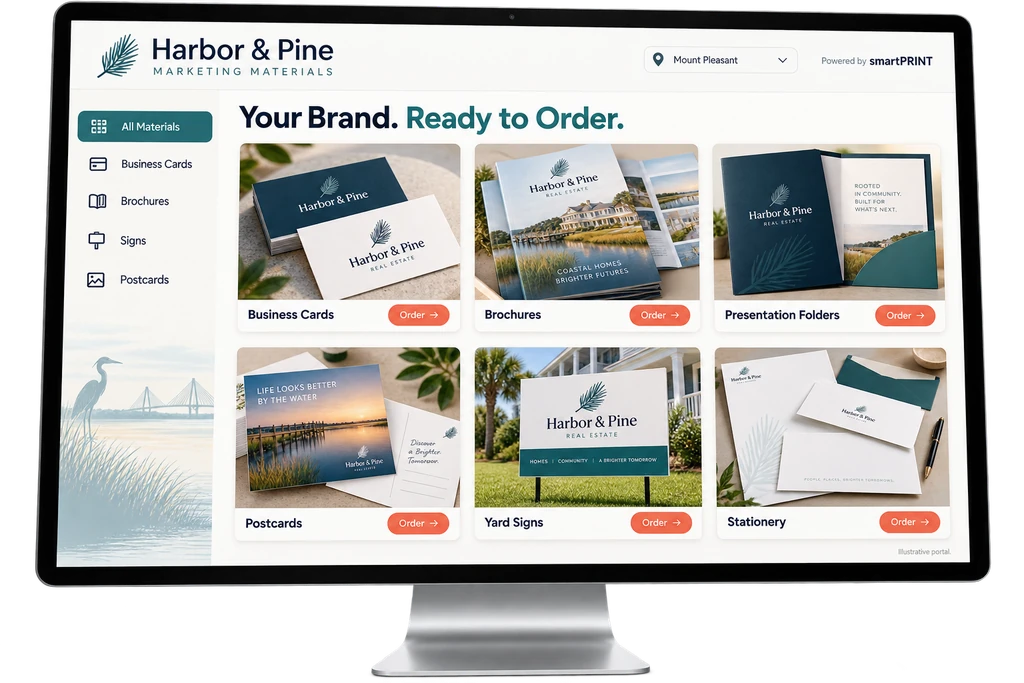
In plain terms, an online print portal is a controlled website that gives authorized users access to your approved printed and branded materials. Think of it as a private storefront built specifically for your organization. Instead of emailing files back and forth, employees log in, see the materials they are allowed to order, enter the information that is approved to change, choose quantities, and submit an order through an established process.
Depending on how the portal is configured, users may be able to reorder frequently used items, customize approved fields, route orders through an approval step, ship to different locations, or see what is currently in inventory. The point is not that ordering happens online. The point is that the organization creates a repeatable, controlled process around materials that get ordered again and again.
Signs You May Have Outgrown Email-Based Print Ordering
Most organizations do not set out to make print ordering complicated. It grows that way. A few warning signs suggest the informal approach has become a liability:
- Multiple people repeatedly order the same products, but no one is sure which file is current.
- Marketing receives routine ordering requests that require manual processing every time.
- Different locations are using different versions of the same brochure or form.
- Employees create their own versions of branded materials because they cannot find the approved one.
- Outdated materials accidentally get reordered because the old file is the easiest to find.
- Too much time is spent emailing files, sending proofs, and confirming which version is correct.
- Brand consistency is slipping as more people place orders from more places.
If several of those sound familiar, the issue is not that your team is careless. The issue is that you are asking an informal system to handle a volume and complexity it was never built for.
Brand Control Without Making Ordering Difficult
One of the most valuable things a well-designed portal does is balance flexibility with control. Employees need enough freedom to do their jobs. The organization needs enough structure to protect the brand. A portal handles both by using approved templates that allow certain information to change while locking other elements in place.
A business card is the simplest example. A user might be allowed to enter their own name, title, phone number, email, and office location. The logo, brand colors, fonts, layout, and any required legal language stay locked. The employee gets a card that is accurate for them. The company gets a card that still looks like the company.
The same idea applies to brochures, forms, signs, stationery, and promotional pieces. Controlled flexibility is the goal. Employees can customize what they are supposed to customize, and nothing else.
Why Multi-Location Organizations Benefit Most
If your organization runs a single office with a small team, a portal may be unnecessary. But the moment you are supporting multiple offices, branches, properties, or franchises, the case gets stronger quickly. A Charleston hospitality group may need property-specific collateral for each hotel. A Mount Pleasant professional service firm with multiple offices may need location-accurate stationery. A Lowcountry property management company may need materials for several communities, each with its own contact information but the same overall branding.
A centralized portal gives local users convenient access to the materials they need while keeping the organization's standards intact. Each location can order what applies to it without creating a new version of everything from scratch.
Reducing Routine Administrative Work
Marketing and operations teams spend a surprising amount of time on repetitive print tasks: finding files, sending artwork, answering questions about what is available, updating contact details, sending proofs, checking approvals, coordinating shipping, and repeating the same instructions to different people.
A portal does not eliminate all of that work, and it would be dishonest to pretend it does. What it can do is move some of the routine, predictable pieces into a defined workflow so your team is not starting from scratch every time someone needs a reorder. The goal is reducing unnecessary repetition, not removing human judgment from the process.
Print on Demand, Inventory, or a Mix?
Different materials call for different production approaches. Some items make sense to produce as orders come in. Others are more economical to run in larger quantities and hold in inventory. Many organizations use a combination, and the right answer depends on the product.
Considerations include how often an item is ordered, how much is used, how frequently the information changes, storage space, obsolescence risk, production economics, and turnaround needs. A high-volume form that never changes may be worth inventorying. A frequently updated promotional piece may be better produced on demand. There is no universal answer, which is why the decision belongs in the planning stage rather than being an afterthought.
Approvals and Permissions
Not every user needs the same access. Depending on how the system is set up, an organization can establish different users, permissions, product visibility, locations, and approval paths. A branch manager might order approved materials directly. A customized item might require marketing approval before it goes to production. Certain products might only be visible to certain departments.
These are configurable possibilities, not guarantees. The point is that a portal can reflect your organization's actual decision-making structure rather than forcing everyone into the same process.
A Portal Should Not Become a Digital Junk Drawer
Here is a mistake worth avoiding. A portal filled with outdated, duplicate, or rarely used products does not solve the original problem. It just moves the clutter online. Before building a portal, it is worth reviewing your current materials and asking some honest questions. Which items are still needed? Which are outdated? Which should be standardized? Which can be eliminated? Which should become templates? Which need updating? Who owns each piece?
That review turns portal development into an opportunity to improve your overall print and collateral system rather than simply digitizing the existing mess.
When an Online Print Portal May Not Be Necessary
Not every organization needs one, and adding technology where it does not solve a real problem just creates unnecessary complexity. A portal may be overkill if only one person orders print, orders are infrequent, most projects are fully custom, you have very few recurring materials, there is no real version-control problem, or your current process is simple and working well.
There is no virtue in a portal for its own sake. The right question is whether the way you order and manage print today is costing you more time and creating more risk than a structured system would.
What to Consider Before Building a Portal
If you are weighing whether a portal makes sense, here is a practical checklist you can bring to an initial conversation:
- Who will use the portal, and how many locations or departments are involved?
- What products do we order repeatedly?
- Which products require customization, and what information should users be allowed to change?
- What elements must remain locked to protect the brand?
- Do orders require approval, and if so, by whom?
- Where should products ship, and should some be produced on demand versus held in inventory?
- Who maintains the approved artwork, and how frequently do products change?
- What specific problems are we trying to eliminate, and how will we know the portal is helping?
The Real Benefit Is the Process, Not the Portal
The technology is not the primary value. The larger benefit is creating a more organized way for people to access, customize, order, approve, produce, and distribute branded materials. A good solution makes life easier for the people ordering while helping the organization maintain appropriate control. When that balance is right, the portal stops feeling like software and starts feeling like a natural extension of how the business already works.
When a company is small, email, shared folders, and individual ordering work fine. As the organization grows, those informal systems start creating friction at exactly the wrong moments. An online print portal becomes valuable when recurring ordering, multiple users, multiple locations, brand control, approvals, inventory, or administrative workload have become real business issues rather than occasional annoyances.
The goal is not adding technology. The goal is simplifying the process.
If your team spends too much time finding files, processing repeat orders, managing approvals, or keeping multiple locations on brand, it may be worth looking at whether an online print portal could simplify the process. Bottom Line Digital Communications can start by reviewing how your organization currently orders and manages materials, then help you determine whether a portal makes sense for your situation.
Let's Talk