
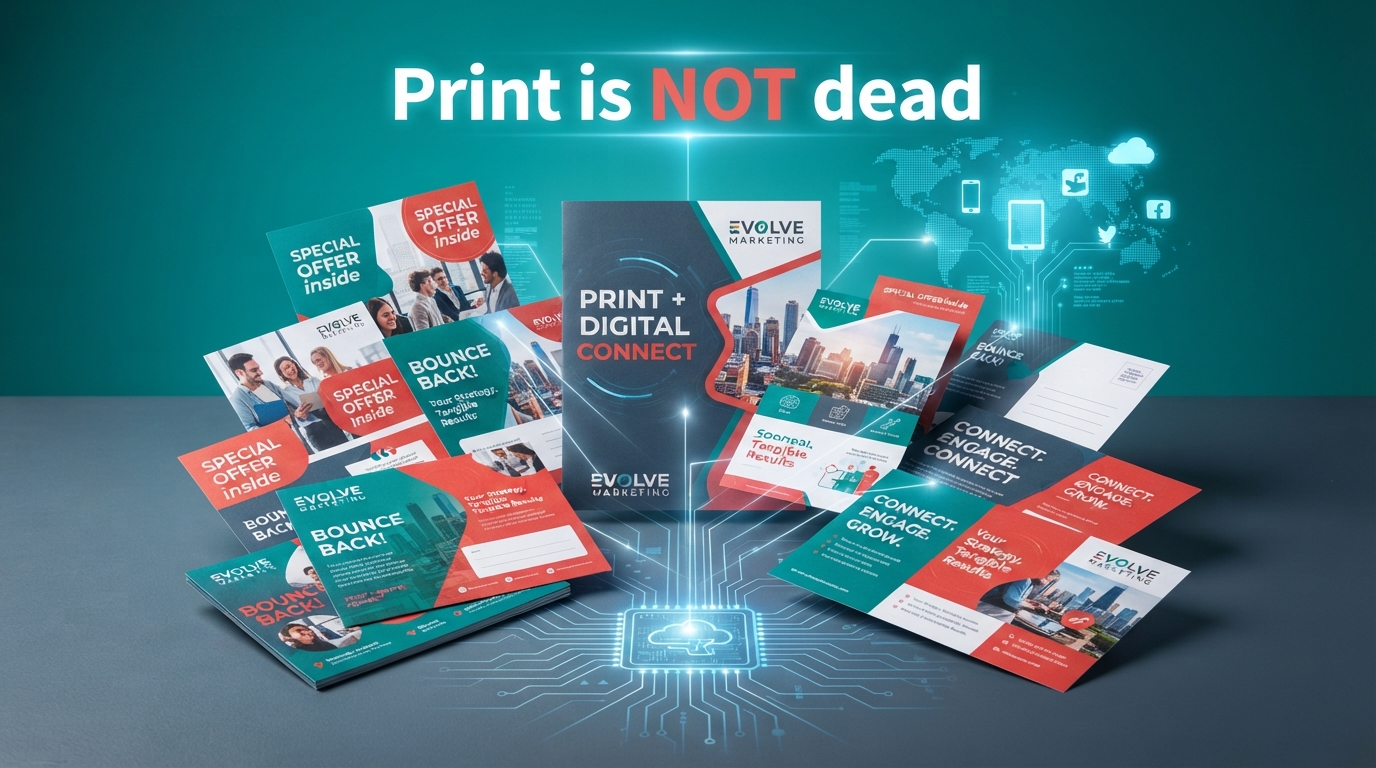
Every few years someone declares print dead. A new platform launches, attention shifts to screens, and the obituary gets written again. And every few years, the businesses that actually keep mailing, printing, and placing tangible pieces in people's hands quietly outperform the ones who went all-digital. Print is not dead. It's just been misunderstood.
The mistake isn't using digital. The mistake is thinking digital replaces print. It doesn't. The two do different jobs, and the businesses winning right now are the ones using print as a deliberate, high-impact part of a connected strategy, not a leftover from the past.
Why Print Still Works
Digital marketing lives in a crowded, scrollable feed where your message competes with a thousand others in the time it takes to blink. Print lives in the physical world, on a kitchen counter, a refrigerator door, a desk. It doesn't get swiped away. It sits there, often for days, quietly building familiarity every time the customer walks past it.
- Print is tangible: A physical piece feels real and credible in a way a banner ad never will.
- Print is scarce: Inboxes overflow; mailboxes don't. A well-designed mailer actually stands out.
- Print can be revisited: A useful physical piece gives customers something they can keep and read again.
- Print is trusted: People tend to trust printed materials more than the average sponsored post.
Print Is a Strategy, Not a Channel
The businesses that get the most out of print don't treat it like a standalone ad. They treat it like the opening move of a sequence. A postcard gets attention. A QR code can open a landing page, while a configured call-tracking number can help attribute calls. A form lets visitors submit their details. Follow-up can support that inquiry when the necessary consent and workflow are in place.
That's the real reason print isn't dead. It's one of the few channels that can reliably reach a local audience with a message they actually hold in their hands. For a neighborhood business trying to reach the homes around it, nothing beats a targeted Every Door Direct Mail drop for starting a conversation that digital alone can't.
Where Print Belongs in Your Funnel
- Top of funnel: EDDM postcards and door hangers introduce you to the homes most likely to buy.
- Mid funnel: Brochures, flyers, and leave-behinds build credibility while a prospect is deciding.
- Retention: Printed thank-yous, referral cards, and seasonal mailers keep past customers coming back.
- Reactivation: A simple mailer to old customers often beats any digital campaign for bringing them back.
The Catch: Print Only Works When It's Connected
Here's where most businesses get print wrong. They mail 5,000 postcards, get a handful of calls, and declare it didn't work. But they never tracked which calls came from the mailer, never gave visitors a clear way to submit an inquiry with appropriate consent, and never measured the leads that came in days later from the piece still sitting on the counter. Print didn't fail. The measurement did.
With suitable tracking and CRM integrations, a campaign can measure selected interactions and help the team respond to inquiries. A QR scan alone does not identify a visitor or authorize email or SMS. Lead capture requires submitted contact details; automated follow-up requires appropriate consent and a configured workflow. Attribution has limits, so report what the setup can actually measure rather than treating every scan as a lead or sale.
Treat print quality as part of the message. Check image resolution at the intended size, choose a suitable stock, and review a proof for readable text and clear contact details. Coordinate the piece with the rest of the campaign so customers can recognize the same business across channels.
Not sure if your print is actually producing? Let's talk. We'll look at how your print and digital channels connect (or don't) and show you exactly where tangible marketing could be driving leads you're not capturing.
Let's Talk