
Most business owners do not have a marketing problem. They have a sorting problem. They have a stack of postcards, a social media calendar, an email list, a website, and maybe a few digital ads, and they are trying to figure out which piece is actually doing the work.
Somewhere along the way, print and digital marketing got framed as rivals. You were either investing in direct mail or you were investing in online ads. Either you were mailing postcards or you were building a funnel. That framing has cost a lot of businesses a lot of opportunity, because print and digital marketing are not competing for the same job. They are two tools that do different things well, and they are far more effective when they work together.
The real question is not which one to choose. It is how each channel can play the right role in a coordinated marketing strategy.
Why Businesses Feel Forced to Choose
The either-or thinking usually starts with budget. Marketing dollars are finite, so when a campaign does not produce obvious results, the next round of decisions gets defensive. A business owner cuts print because it feels old-fashioned, or they pull back on digital because it feels like throwing money into a void.
The choice also gets framed by vendors. A print provider talks up the power of direct mail. A digital agency talks up the precision of online targeting. Each has a point, but neither is telling the whole story, because neither is looking at the complete marketing picture. When you only sell one tool, every problem looks like it needs that tool.
The result is a lot of businesses running parallel marketing efforts that never connect. A postcard goes out with no follow-up. A digital ad runs with no offline reinforcement. A website collects traffic that never turns into a conversation. The channels are not failing. They are just working alone.
What Print Does Well
Print has a quality that digital cannot replicate: physical presence. A postcard sitting on a kitchen counter is not competing with a hundred browser tabs. A brochure in a waiting room is not fighting a notification. Print exists in the real spaces where your customers already are, and it stays there.
That physical presence does a few important things:
- It earns attention in environments where screens are put away or ignored.
- It builds credibility. A well-printed piece signals that a business is established and invested.
- It reinforces brand recognition through consistent logos, colors, and messaging a customer can hold.
- It reaches specific local areas with precision, which is one reason direct mail remains a strong tool for neighborhood-based businesses across the Lowcountry.
Print is especially good at the top of a customer journey. It introduces a business, creates a first impression, and plants a message in a place where it can be noticed without competing against a crowded screen.
What Digital Does Well
Digital marketing is built for interaction. Where print creates presence, digital creates response. A customer can click, fill out a form, watch a video, save an offer, or start a conversation in seconds.
Digital also gives you something print cannot: a way to continue the relationship. Once someone interacts online, you can follow up with an email, retarget them with a relevant ad, or guide them to a specific next step. You can measure what is happening in close to real time, and you can adjust.
Where print is strong at earning attention and building trust, digital is strong at:
- Capturing leads through forms, calls, and messages.
- Delivering deeper information when a customer is ready to learn more.
- Following up automatically with people who showed interest.
- Measuring engagement so you can see what is working and what is not.
Why Combining Them Creates a Stronger Journey
Here is where the two channels stop competing and start helping each other. A printed piece can generate attention and trust. Digital can provide the immediate next step that turns that attention into action.
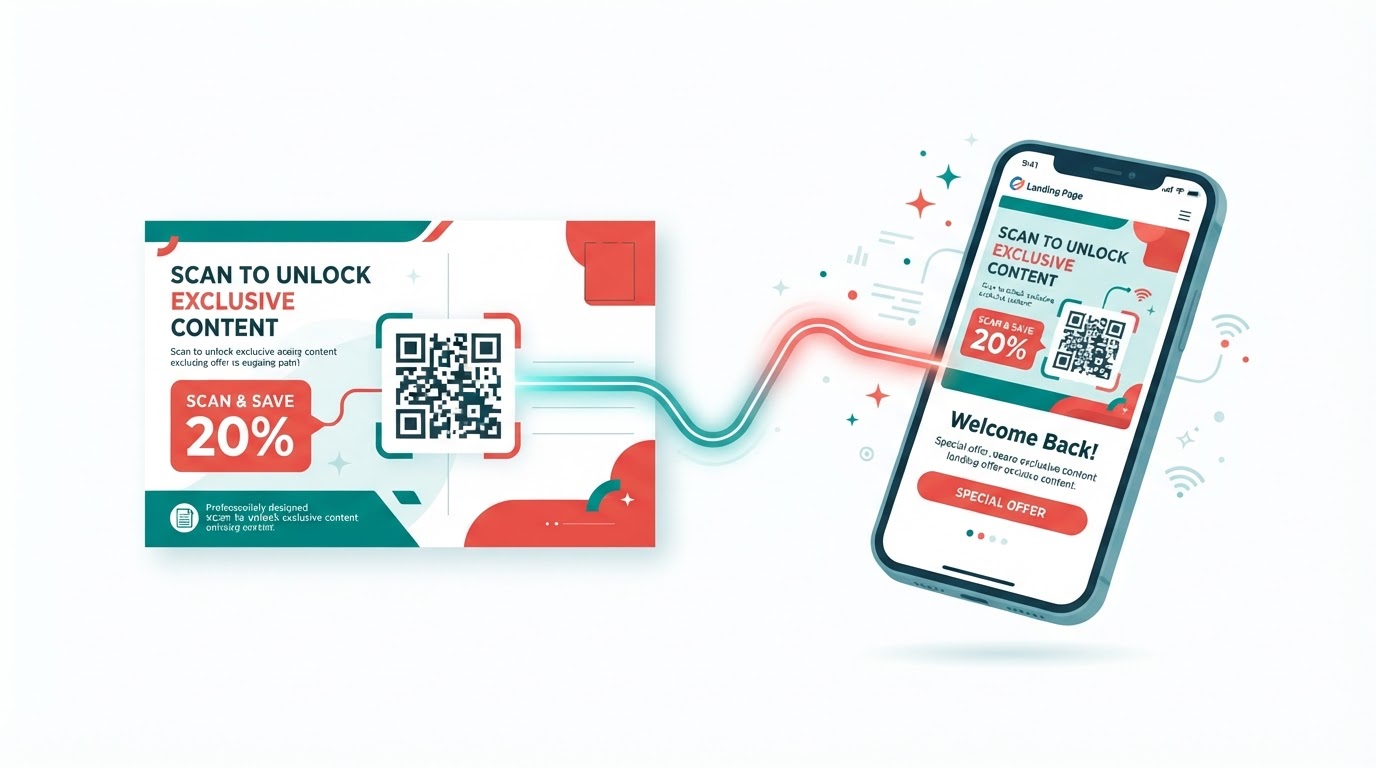
Think about a direct mail postcard that arrives in a Mount Pleasant neighborhood. On its own, it might create awareness. But if that postcard includes a QR code that leads to a campaign-specific landing page, the customer can go from noticing your business to engaging with it in a few seconds. The landing page can capture their contact information, and an automated follow-up sequence can keep the conversation going.
Print did the hard part: it got noticed in a low-distraction environment. Digital did the fast part: it made responding effortless. Neither channel carried the whole load, and the customer experience felt smooth instead of fragmented.
Practical Ways to Connect Print and Digital
The connection does not have to be complicated. A few well-planned pairings can turn a one-way message into a two-way conversation.
- A direct mail postcard with a QR code leading to a landing page built for that specific offer.
- An event invitation that directs recipients to online registration instead of asking them to call.
- A printed leave-behind for a sales meeting that connects a prospect to a short video or a detailed service page.
- A restaurant promotion that moves customers from a printed table card to an online offer or loyalty signup.
- A real estate mailer that links recipients to a property gallery or a schedule-a-showing page.
- A nonprofit appeal that provides an easy digital donation path right from a printed letter.
- In-store signage or window graphics that encourage mobile interaction with a special offer.
Each of these examples shares the same structure: print earns the attention, and digital delivers the next step. That is the core of an integrated marketing campaign.
Consistency Is What Makes It Feel Connected
Connecting channels only works if the experience feels like one business. If a postcard uses one color palette and tone, and the landing page it links to looks and sounds completely different, the customer feels a break in trust. They wonder if they ended up in the right place.
Every piece of a campaign, the printed mailer, the landing page, the website, the digital ad, the follow-up email, should look and sound like it came from the same organization with the same purpose. That consistency is what turns a series of touches into a single, coherent customer journey.
Measurement and Follow-Up
One of the quiet advantages of connecting print to digital is that it creates opportunities to understand engagement. When a QR code on a postcard leads to a tracked landing page, you can see how many people responded. When a form captures a name and email, you can follow up with people who showed genuine interest.
This is not about tracking every single interaction or attributing every sale to a single touch. Marketing rarely works that cleanly. It is about giving yourself enough signal to know whether a campaign is gaining traction and where to invest more next time. A connected campaign gives you more of that signal than two isolated efforts ever will.
Strategy Comes Before Tactics
Here is the part that is easy to skip: adding a QR code to a postcard does not automatically create an integrated marketing strategy. A QR code is a tactic. A landing page is a tactic. Neither one is a plan.
Before any piece gets produced, the campaign needs a clear answer to a few questions: Who is the audience? What is the message? What is the offer? What is the next step we want them to take? And what business goal is this campaign supposed to move? Without those answers, you are connecting tactics without connecting them to a purpose.
A Simple Planning Framework
Before launching your next campaign, work through these questions. They do not require a marketing degree, and they will do more for your results than any single channel choice.
- Who are we trying to reach?
- What problem are we helping them solve?
- What do we want them to understand?
- What action do we want them to take?
- Which channel is best for getting their attention?
- Where should they go next, and how easy is that next step?
- How will we follow up with people who respond?
- How will we know whether the campaign is helping us reach our goal?
When you can answer those questions, the channel choices almost make themselves. You stop asking whether print or digital is better, and you start asking which one is right for this specific job.
How BLDC Connects the Pieces
This is where it helps to have a partner who can see the whole picture instead of selling one piece of it. Bottom Line Digital Communications works across commercial printing, direct mail, graphic design, website design, wide-format signage, and digital marketing. That range matters, because it means the same team that prints your postcard can build the landing page it links to, design the signage that reinforces the offer, and plan the follow-up that keeps the conversation going.
smartPRINT is the bridge between a traditional printed piece and that digital next step. Through QR codes, campaign landing pages, lead capture, and trackable engagement, smartPRINT turns a static print piece into an interactive marketing experience. It is the connection point that lets a printed postcard, brochure, or sign hand off smoothly to a digital conversation.
From there, BOOST. represents the broader, coordinated approach to ongoing marketing. The natural progression is simple: start with an effective printed communication, connect it to digital interaction through smartPRINT, and build toward a more comprehensive marketing system through BOOST. You do not have to do all of it at once. The point is that the path exists, and each step connects to the next instead of starting over.
Instead of coordinating several unrelated vendors, a business in Charleston, Mount Pleasant, or anywhere in the Lowcountry can work with one local partner who understands how these pieces fit together and how to make them work as a system.
You Do Not Have to Choose
Print and digital marketing are not in competition. They are two halves of a more complete customer journey. Print earns attention and builds trust in the physical world. Digital makes it easy to respond, learn more, and stay connected. When they are strategically connected, each one makes the other more useful.
If you are planning a print campaign, a digital campaign, or a little of both, the most valuable first step is not picking a channel. It is stepping back, looking at the goal, and deciding how the pieces should work together.
Planning a campaign that uses print, digital, or both? Let's look at it together. We will help you see the whole picture, identify where print and digital should connect, and build a coordinated plan where every piece has a purpose and a clear next step.
Let's Talk