
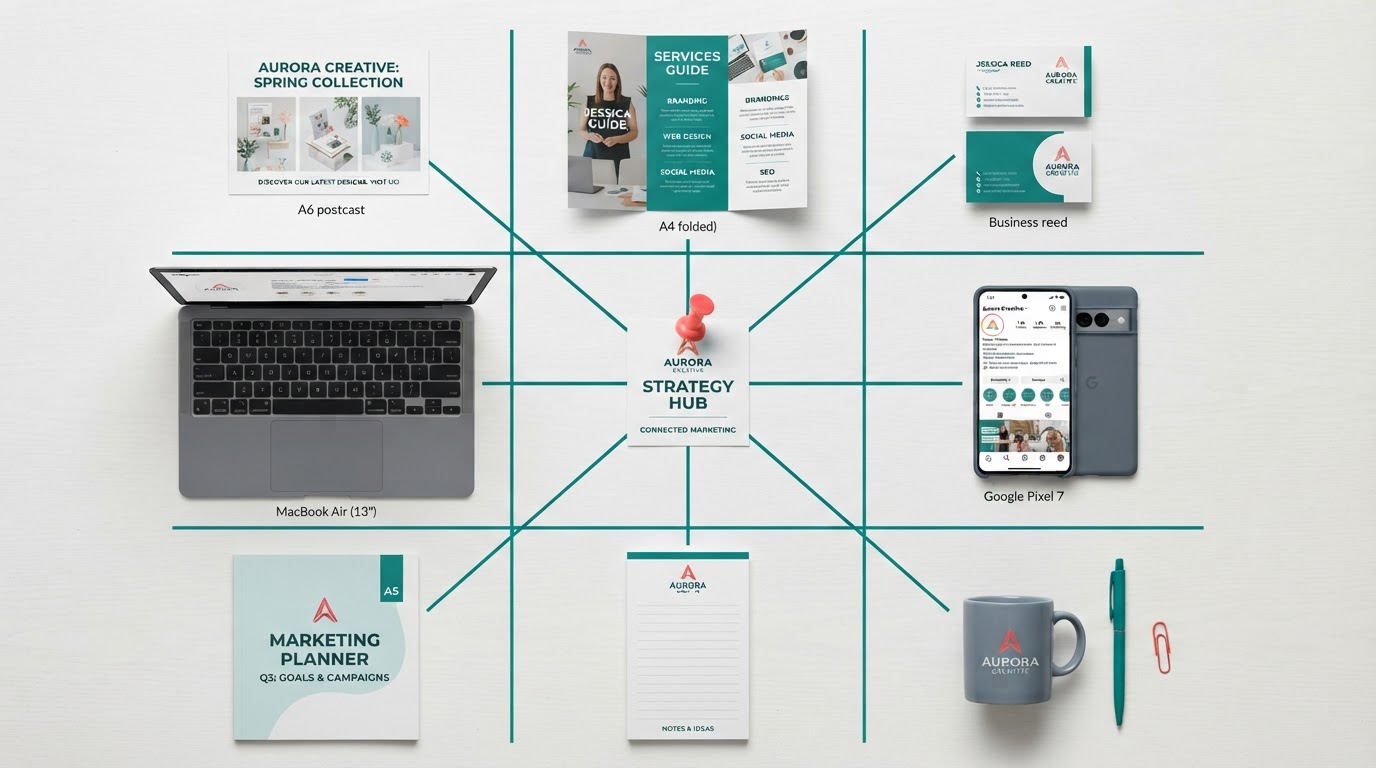
You are posting on social media, sending emails, printing flyers, running ads, updating your website, and showing up at networking events. You are doing a lot. But when someone asks what is actually working, you do not have a clear answer.
That is one of the most common feelings we hear from small business owners across the Lowcountry. There is no shortage of marketing activity. There is often a shortage of marketing strategy. Activity keeps you busy. Strategy makes that activity produce something.
The difference matters. More marketing does not necessarily produce better marketing. A clear strategy gives each channel a purpose and connects individual tactics to a specific business goal. Without it, you are paying for effort instead of results.
Signs Your Marketing Is Disconnected
Disconnected marketing rarely announces itself. It shows up quietly in the everyday details of running a business. See if any of these feel familiar.
- Your social media posts, email campaigns, and printed materials all say something slightly different about your business.
- You cannot quickly say which channel is driving new leads or sales.
- You started a new marketing effort because someone recommended it, not because it fit a plan.
- Your website talks about one set of services, but your ads and flyers promote something else.
- You measure effort (posts published, emails sent, flyers printed) but not outcomes (calls, form submissions, appointments, revenue).
If two or three of those sound like your business, the good news is the fix is not to do more marketing. The fix is to do more intentional marketing.
Activity versus Strategy
Activity answers the question, "What are we doing?" Strategy answers the question, "Why are we doing it, and how does it move the business forward?"
Activity looks like a full calendar of posts and a printed direct mail piece going out every quarter. Strategy looks like a direct mail campaign that targets a specific neighborhood in Mount Pleasant, drives people to a landing page built for that offer, and is followed up with an email to anyone who scanned the QR code on the card.
The first version keeps you busy. The second version is a connected small business marketing strategy where every piece knows its job and reports back on whether it did it.
Why Consistency Matters More Than Volume
A customer might see your name on a Facebook ad, then a print brochure in their mailbox a week later, then your Google Business listing when they search for you. If each of those touches looks and sounds like the same business, trust builds. If they feel like three different companies, confidence erodes.
Consistency is not about using the exact same words everywhere. It is about one clear message, one recognizable look, and one promise that shows up however people find you. That consistency is what turns scattered attention into a decision to contact you.
Connecting Print and Digital
One of the fastest ways to disconnect a marketing plan is to treat print and digital like separate worlds. They are not. They are two delivery methods for the same message, and they are far more effective when they work together.
A well-placed direct mail piece can introduce an offer to a neighborhood. A QR code on that piece can drive recipients straight to a landing page. That page can capture a name and email, which feeds an email sequence that follows up with a limited-time incentive. A counter card in your waiting area can reinforce the same offer for anyone who walks in.
Each piece is doing a specific job. None of them is carrying the whole load alone. That is an integrated marketing strategy in action, and it is exactly the kind of connection BLDC builds for clients across the Charleston area.
Identifying the Customer and the Message
Before you choose a single channel, two questions have to be answered honestly: Who is the customer you are trying to reach, and what do you want them to understand?
A coffee shop near Isle of Palms trying to grow its morning commuter traffic is speaking to a different person than a professional services firm in downtown Charleston trying to fill consultations. The channels, the offer, and the message should reflect that difference.
When you start with the customer instead of the product, every decision that follows becomes clearer. The right audience tells you the right channel. The right channel tells you the right format. The right format tells you the right call to action.
Setting Measurable Goals
A goal you cannot measure is a wish. Measurable goals give every marketing effort a job description and a performance review.
- Instead of "grow awareness," aim for a specific number of website visits from a certain ZIP code.
- Instead of "get more leads," aim for a set number of form submissions or calls per month.
- Instead of "post more on social," aim for a specific number of qualified inquiries traced back to social.
Goals like these tell you exactly when something is working and when it is not. They also tell you where to invest more and where to stop spending. Marketing ROI is much easier to see when you stopped measuring effort and started measuring outcomes.
Creating a Simple Marketing Roadmap
A strong marketing plan does not need to be a 40-page document. It needs to answer a handful of questions and live somewhere you can actually use it. Here is a simple version that works for most small businesses.
- Who is the customer, and what problem are you solving for them?
- What is the single most important message you want them to hear?
- Which two or three channels make the most sense for reaching them?
- What does each channel need to do, and how will you measure it?
- What is the offer, and what is the clear next step you want them to take?
When you can answer those five questions, you have a roadmap. Every flyer, post, email, and ad you produce has a reason for existing and a way to be evaluated. You are no longer guessing. You are running a plan.
When Outside Guidance Makes Sense
There is a reason many small business owners reach a point where doing more marketing does not feel like the answer. They do not need more activity. They need someone who can step back, look at the whole picture, and help them see which pieces are pulling their weight and which ones are just adding noise.
That is the role Bottom Line Digital Communications plays for businesses across the Lowcountry. BLDC is not here to sell you one isolated product. We look at your print, your web presence, your direct mail, your signage, and your digital campaigns together, as one system. Then we help you build a marketing plan where every piece has a purpose and every dollar has a job.
You know your business and your customers better than anyone. Our job is to turn that knowledge into a connected strategy that produces results you can actually measure.
Ready to Find Out What Is Actually Working?
If you are doing a lot of marketing but you are not sure what is working, the most useful next step is not to add another tactic. It is to step back and look at the whole plan together.
That is exactly what a free marketing review with BLDC gives you. We will look at your current marketing across print, digital, web, and signage, identify where the pieces are connected and where they are not, and show you where a simple change could turn busy into effective.
Want to see how your marketing fits together? Let's talk. We will review your current channels, identify the gaps, and show you exactly where a connected small business marketing strategy could be driving results you are not capturing today.
Let's Talk