
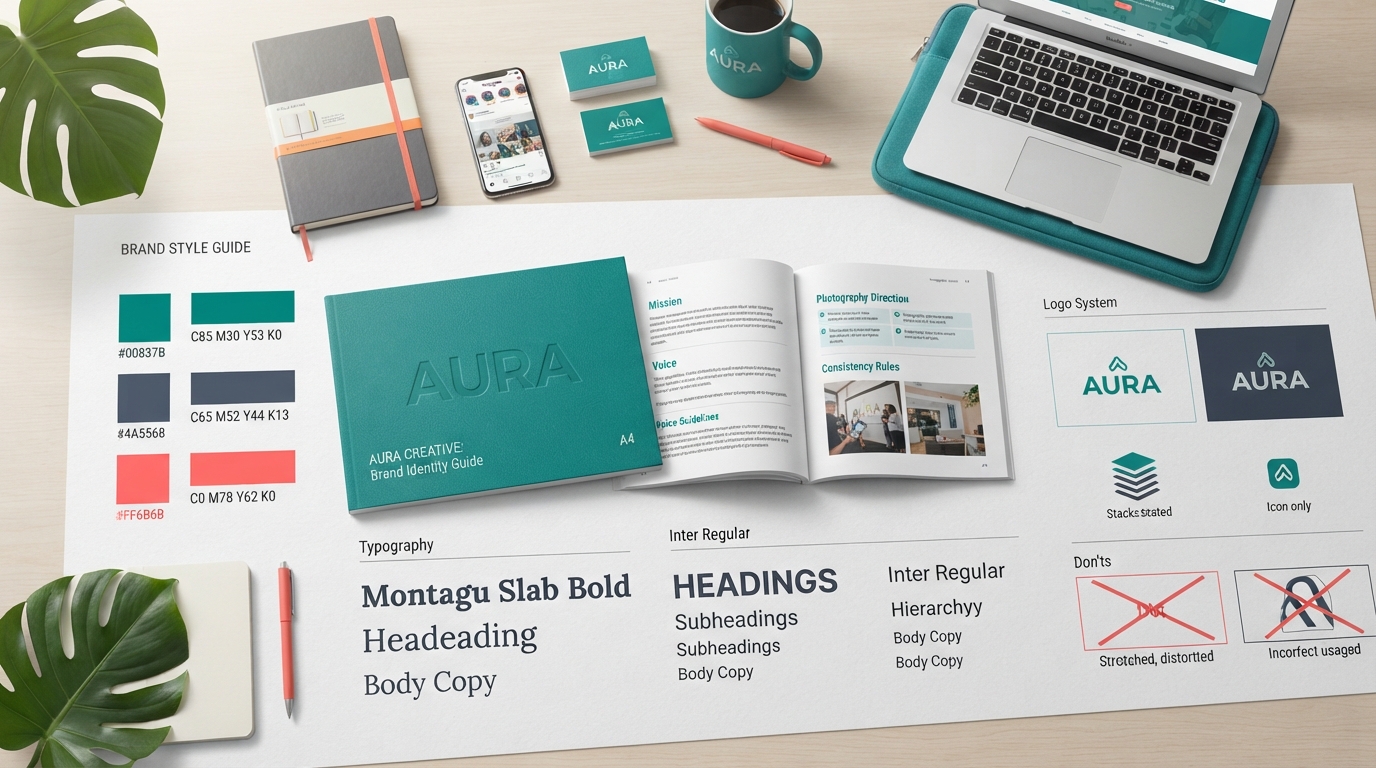
Ask most business owners what their brand is and they'll point to a logo. But a logo is just a mark. Your brand is the accumulated feeling people get every time they encounter your business, the postcard in their mailbox, the website on their phone, the reply to their inquiry, the sign on your building. When all of those moments feel like they came from the same place, you have brand consistency. When they don't, you have brand confusion, and confusion costs you customers.
The businesses that grow predictably aren't always the ones with the cleverest campaigns. They're the ones that show up looking, sounding, and acting like the same competent company everywhere they appear. That doesn't happen by accident. It happens because someone wrote it down.
What a Brand Guide Actually Is
A brand guide is a single source of truth for how your business presents itself. It defines your colors, your fonts, your logo usage, your voice, your spacing, and the rules that keep all of it from drifting. It's not a creative restriction. It's a decision-making shortcut that lets anyone on your team, or any vendor you hire, produce something that looks like you instead of like them.
Without a guide, every new project starts from scratch. The printer guesses at your teal. The web designer picks a font that's close enough. The social intern writes in a tone that sounds nothing like your last email. Individually, each choice seems fine. Together, they make your business look like five different companies sharing a name.
Why Consistency Outperforms Creativity
There's a reason the biggest brands in the world are almost boring in their consistency. Familiarity builds recognition, and recognition builds trust. A customer needs to encounter your brand several times before it sticks. If each encounter looks or sounds different, you reset that clock every time. You're not building recognition, you're starting over with every touchpoint.
- Consistency builds recognition: The more repeatable your look and voice, the faster people remember you.
- Recognition builds trust: People trust what feels familiar and established, not what feels improvised.
- Trust builds conversion: A credible, consistent brand converts the same traffic at a far higher rate.
- Consistency saves money: You stop paying every vendor to reinvent your identity from scratch.
The Cost of Inconsistency
Inconsistency is rarely loud. It's a slow leak. A customer gets a polished direct mail piece, lands on a website that uses a different shade of your color and a different font, and quietly wonders if they're in the right place. They may not say it, but they feel it. And feeling unsure is all it takes for them to hit the back button and call the next business on the list.
Every mismatched touchpoint taxes the customer's confidence. Stack enough of them and you've made your marketing work twice as hard for half the result. The fix isn't more creativity. It's more discipline.
What Every Brand Guide Should Include
- Color palette: Exact hex, RGB, and CMYK values for every brand color, plus rules for tints and accessibility.
- Typography: Which fonts, which weights, which sizes, and where each is used. No guessing.
- Logo usage: Approved variants, clear space, minimum sizes, and a clear list of what not to do.
- Voice and tone: How you sound, not just how you look. The personality that carries across every channel.
- Spacing and layout: A shared rhythm so everything you produce feels proportioned and intentional.
- Imagery direction: The kind of photos and graphics that fit, and the kind that don't.
A Guide Only Works If It's Used
The most common failure isn't not having a brand guide. It's having one that lives in a forgotten PDF. A guide earns its keep when it becomes the first thing you hand a new vendor, the reference you check before approving a proof, and the standard you hold every touchpoint to. Make it short, make it clear, and make it easy to find.
When your print, your website, your social, and your follow-up all pull from the same guide, something shifts. Your marketing stops feeling like a pile of separate projects and starts feeling like one confident business. Customers stop wondering whether you're legit and start wondering when they can get started.
Not sure how consistent your brand really is across print and digital? Let's talk. We'll review your messaging clarity, visual consistency, and follow-up, and show you exactly where your brand is leaking trust.
Let's Talk